
What Alabama Injury Victims Need to Know Before Filing a Claim
If you were hurt in an accident in Alabama, the laws that apply to your case are different from almost every other state. Alabama uses a strict contributory negligence rule that can block your entire claim if you share even a small amount of fault. The state also imposes a firm two-year deadline to file a lawsuit, and wrongful death cases follow their own unusual rules for damages.
Request a free consultation to have your Alabama personal injury case reviewed at no cost.
Understanding these rules early can make a real difference in whether you recover compensation. This guide breaks down the specific Alabama laws that affect personal injury claims, from filing deadlines to fault rules to the types of damages you may be able to collect.
Alabama’s Statute of Limitations for Personal Injury Claims
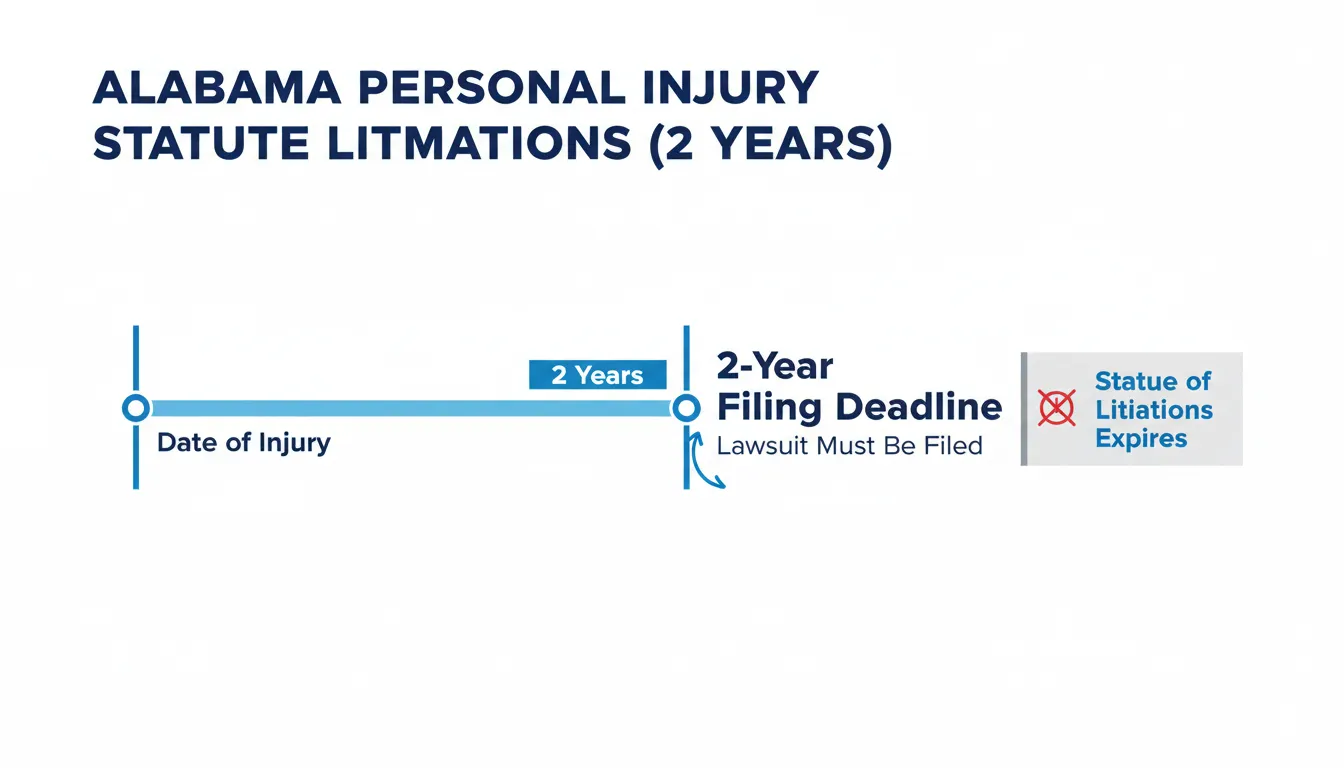
Under Alabama Code 6-2-38(l), you have two years from the date of your injury to file a personal injury lawsuit. This deadline applies to most accident cases, including car accidents, truck accidents, motorcycle crashes, and pedestrian injuries.
If you miss this two-year window, the court will almost certainly dismiss your case. Alabama courts enforce this deadline strictly, with very few exceptions.
Deadlines for Specific Case Types
While two years is the general rule, certain types of claims have their own timelines:
- Property damage claims: Two years from the date of damage under Alabama Code 6-2-38(l). This matters when both personal injury and property damage happen in the same accident, since each may have a separate deadline.
- Medical malpractice claims: Two years from the date of the negligent act under Alabama Code 6-5-482. Alabama also has a four-year statute of repose, meaning no claim can be filed more than four years after the medical error occurred, even if you did not discover the injury right away. An exception exists for cases involving a foreign object left inside the body during surgery.
- Wrongful death claims: Two years from the date of death under Alabama Code 6-2-38(l). Only a personal representative of the deceased person’s estate can file this type of claim.
- Claims against government entities: You must file a notice of claim within shorter timeframes. Claims against a city typically require notice within six months. State government claims follow the Alabama Tort Claims Act and have their own procedures.
When the Clock Pauses
Alabama law allows “tolling,” or pausing, of the statute of limitations in limited situations. If the injured person was a minor at the time of the accident, the two-year clock does not begin until they turn 19 (the age of majority in Alabama). If the defendant hid their wrongful conduct through fraud, the deadline may be extended until the injury is discovered.
How Does Contributory Negligence Work in Alabama?
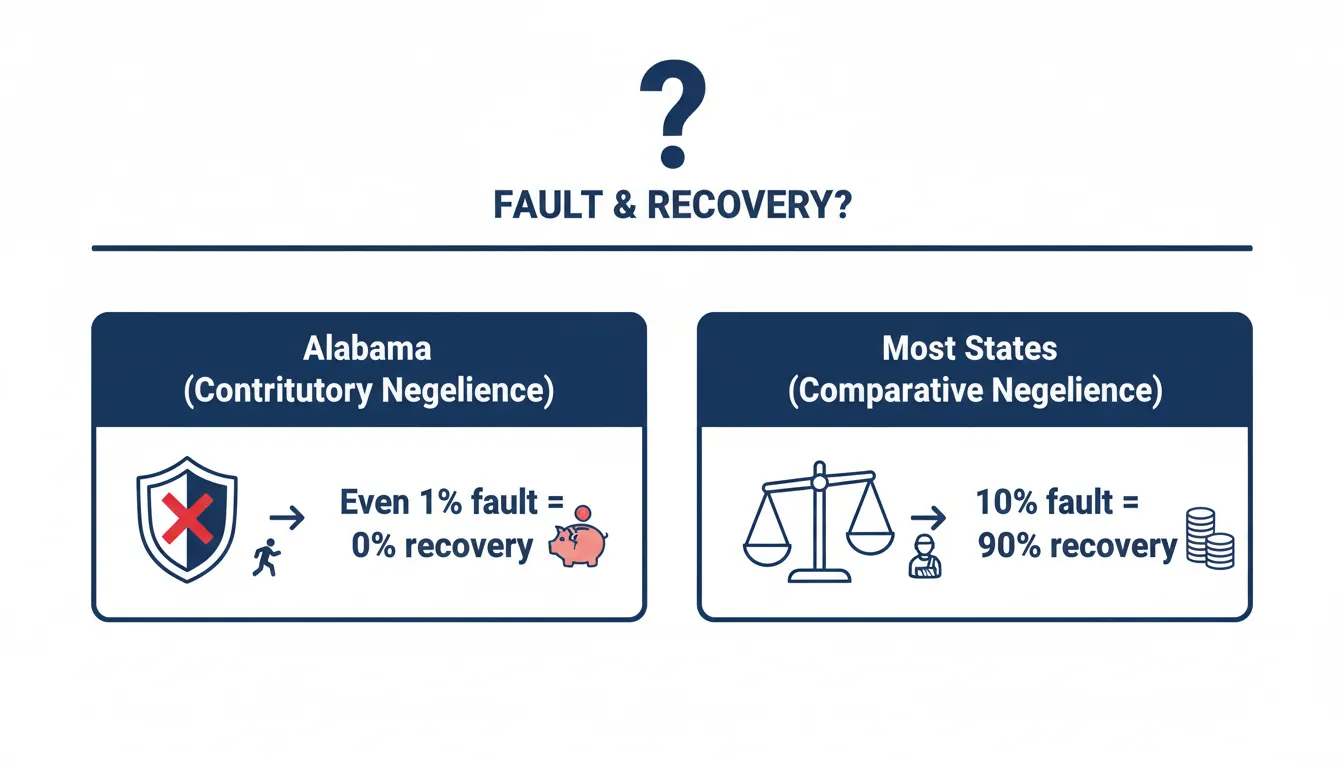
Alabama follows the doctrine of pure contributory negligence. This is one of the strictest fault rules in the country. Only three other states (Maryland, North Carolina, and Virginia) plus Washington, D.C. still use this system.
Under contributory negligence, if a court finds that you were even 1% at fault for the accident that caused your injuries, you are completely barred from recovering any damages. There is no partial recovery. The defendant does not have to prove you were mostly at fault. Any fault on your part can end your claim entirely.
Wondering whether contributory negligence could affect your case? Get a free case evaluation from an experienced Alabama attorney in our network.
Real-World Example
Say you are driving through an intersection in Birmingham when another driver runs a red light and hits your car. You suffer a broken arm and $50,000 in medical bills. However, evidence shows you were going 5 miles per hour over the speed limit at the time of the crash. Under Alabama’s contributory negligence rule, the other driver’s insurance company could argue you contributed to the accident by speeding. If the jury agrees, you could be barred from recovering anything, even though the other driver clearly caused the crash by running the red light.
The Last Clear Chance Doctrine
Alabama courts do recognize one important exception to contributory negligence: the “last clear chance” doctrine. If the defendant had the last clear opportunity to avoid the accident and failed to act, the plaintiff may still recover damages despite their own negligence. This exception can be difficult to prove, but it has saved claims that would otherwise be lost under the contributory negligence rule.
Types of Damages You Can Recover in Alabama
If your personal injury claim is successful, Alabama law allows you to seek three main categories of damages: economic damages, non-economic damages, and in certain cases, punitive damages.
Economic Damages
Economic damages cover the measurable financial losses caused by your injury. These include:
- Medical bills (past and future treatment costs)
- Lost wages and reduced earning capacity
- Rehabilitation and therapy expenses
- Out-of-pocket costs like medical equipment, home modifications, or transportation to appointments
There is no cap on economic damages in Alabama personal injury cases.
Non-Economic Damages
Non-economic damages compensate you for losses that are harder to measure in dollar terms. Common examples include:
- Physical pain and suffering
- Emotional distress and mental anguish
- Loss of enjoyment of life
- Loss of consortium (the impact on your relationship with a spouse)
Alabama does not place a cap on non-economic damages in standard personal injury cases. The Alabama Supreme Court struck down previous non-economic damage caps as unconstitutional in Moore v. Mobile Infirmary Association, ruling they violated the right to trial by jury and equal protection.
Punitive Damages
Punitive damages are meant to punish the defendant for particularly harmful behavior and discourage others from acting the same way. In Alabama, punitive damages are only available in cases involving oppression, fraud, wantonness, or malice.
Alabama Code 6-11-21 does cap punitive damages:
- Cases involving physical injury: The greater of three times compensatory damages or $1.5 million
- Cases without physical injury: The greater of three times compensatory damages or $500,000
These caps do not apply to wrongful death cases or cases involving intentional physical injury.
Alabama Wrongful Death Claims: A Unique System
Alabama handles wrongful death differently from any other state. Under Alabama’s wrongful death statute (Alabama Code 6-5-410), damages in a wrongful death case are entirely punitive. The surviving family members cannot recover compensatory damages for medical bills, funeral costs, or lost income through the wrongful death claim itself.
Instead, a jury determines the punitive damages based on the severity of the defendant’s wrongful conduct. This means the amount awarded depends more on how bad the defendant’s behavior was than on the financial losses the family suffered.
This unique rule often surprises families who expect to recover for their loved one’s medical expenses or funeral costs through a wrongful death lawsuit. A separate survival action may allow recovery of the deceased person’s damages (like medical bills and pain) from the time of injury until death.
What Types of Personal Injury Cases Are Common in Alabama?
Alabama sees personal injury claims across a wide range of accident types. The most common include:
- Car accidents: Alabama requires minimum liability insurance of 25/50/25 ($25,000 per person, $50,000 per accident for bodily injury, and $25,000 for property damage). With over 800 fatal crashes reported in recent years, motor vehicle accidents remain one of the leading sources of personal injury claims in the state.
- Truck accidents: Alabama’s position along major interstate corridors (I-65, I-20, I-59) means commercial truck crashes are common. These cases often involve federal trucking regulations in addition to state law.
- Motorcycle accidents: Alabama does not require a motorcycle helmet for riders over 21 who have held their license for more than a year. However, not wearing a helmet could be used as evidence of contributory negligence.
- Slip and fall accidents: Property owners in Alabama must keep their premises reasonably safe. Visitors who slip on a wet floor, trip on uneven pavement, or fall due to poor lighting may have a premises liability claim.
- Medical malpractice: Alabama requires an expert medical opinion before filing a medical malpractice lawsuit. The Alabama Medical Liability Act (Alabama Code 6-5-480) sets specific rules for these cases, including the statute of repose mentioned above.
- Dog bites: Alabama follows a “one-bite rule” combined with statutory strict liability. Under Alabama Code 3-6-1, a dog owner is liable for injuries if the dog was at large and the victim did not provoke the animal. A separate common law negligence claim may also apply if the owner knew the dog was dangerous.
How Do Insurance Companies Handle Claims in Alabama?
Insurance companies in Alabama know the state’s contributory negligence rule gives them a strong defense. Adjusters will look for any evidence that you shared fault in the accident, because even a small amount of blame on your part can eliminate their obligation to pay.
Common tactics insurance companies use in Alabama include:
- Recording your statement early, hoping you say something that suggests you could have prevented the accident
- Requesting broad access to your medical records to look for pre-existing conditions they can blame for your symptoms
- Offering a fast, low settlement before you fully understand your injuries or the long-term costs of treatment
- Arguing you failed to mitigate your damages by not following your doctor’s treatment plan
Alabama’s mitigation of damages rule requires injured plaintiffs to take reasonable steps to avoid making their injuries worse. If an insurance company can show you skipped necessary medical treatment, they may argue your damages should be reduced.
Before accepting any insurance offer, talk to an attorney who knows Alabama personal injury law. The initial consultation is free.
Steps to Take After an Injury in Alabama
What you do in the hours and days after an accident can shape your entire case. These steps help protect your legal rights under Alabama law:
- Get medical attention immediately. See a doctor even if your injuries seem minor. Medical records from the day of the accident create a direct link between the incident and your injuries. Gaps in treatment give insurance companies an opening to argue your injuries are not serious.
- Report the incident. File a police report for car accidents. Report workplace injuries to your employer. Notify the property owner for slip and fall accidents. Official reports create a record that supports your timeline.
- Document everything. Take photos of the accident scene, your injuries, vehicle damage, road conditions, and any hazards. Save receipts for medical bills, prescriptions, and any expenses related to your injury.
- Avoid giving recorded statements to the other driver’s insurance company. You are not required to give a recorded statement. Anything you say can be used to argue contributory negligence.
- Keep a recovery journal. Write down your daily pain levels, limitations, and how the injury affects your routine. This documentation supports non-economic damage claims for pain and suffering.
- Contact a personal injury attorney early. Because Alabama’s contributory negligence rule is so strict, building a strong case from the start is especially important. An attorney can help preserve evidence, handle insurance communications, and protect you from common defense tactics.
Frequently Asked Questions About Alabama Personal Injury Law
How long do I have to file a personal injury lawsuit in Alabama?
You have two years from the date of your injury under Alabama Code 6-2-38(l). Medical malpractice claims also have a two-year deadline, plus a four-year statute of repose. Missing this deadline means losing your right to sue.
Can I still recover damages if I was partly at fault?
Generally, no. Alabama’s contributory negligence rule bars you from any recovery if you share even 1% of fault. The “last clear chance” doctrine is a limited exception that may apply if the defendant had the final opportunity to prevent the accident.
Is there a cap on personal injury damages in Alabama?
There is no cap on economic or non-economic damages in most personal injury cases. Punitive damages are capped at the greater of three times compensatory damages or $1.5 million for cases involving physical injury. Wrongful death cases and intentional injury cases are not subject to punitive damage caps.
What makes Alabama personal injury law different from other states?
Two things stand out. First, Alabama is one of only four states that still use pure contributory negligence, which can completely block your claim for any shared fault. Second, Alabama’s wrongful death statute only allows punitive damages, not compensatory damages, making it unique in the entire country.
Do I need a lawyer for a personal injury claim in Alabama?
You are not required to hire a lawyer, but Alabama’s contributory negligence rule makes legal representation especially valuable. Insurance companies actively look for ways to assign even minor fault to the injured person. An experienced attorney understands how to counter these arguments and protect your right to compensation.
Protect Your Rights Under Alabama Law
Alabama’s personal injury laws are among the most demanding in the country. The contributory negligence rule, strict filing deadlines, and unique wrongful death rules all create challenges that can catch injury victims off guard. Knowing how these laws work is the first step toward protecting your claim.
The attorneys in the Counsel Hound network are vetted for their experience handling Alabama personal injury cases. Every attorney goes through a background check, reputational review, and track record investigation before joining the network.
Request your free consultation today and get matched with an Alabama personal injury attorney who can evaluate your case at no cost.
If you need an experienced Alabama personal injury lawyer to evaluate your claim and navigate these Alabama-specific rules, Counsel Hound can connect you with a vetted attorney today.